
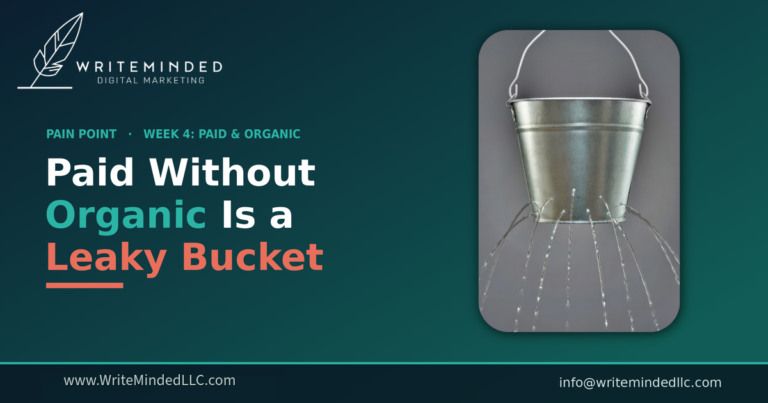
If you paused all paid spend tomorrow, how much of your visibility would survive the week? For a lot of companies, the honest answer is “not much,” because every dollar of visibility was rented, never owned, and it disappears the moment the spend stops. That is the leaky bucket problem: paid advertising pours traffic in at the top while the absence of organic content lets it drain straight out the bottom, so the program only works for as long as the invoice is being paid.
What is the “leaky bucket” problem in marketing?
It is a marketing program that depends entirely on paid advertising for visibility, so traffic and leads stop almost immediately when spending stops, because no owned organic assets exist to keep producing in the background. Paid media fills the bucket; organic content is what seals the holes. Picture a company spending $10,000 a month on ads with strong returns: pause that spend, and within a week the leads are gone, because nothing was built to keep producing once the payments stopped. Without that organic layer, every result you see is temporary by design, and you are effectively re-buying the same visibility over and over instead of building anything that lasts.
Why does a paid-only strategy behave like a leaky bucket?
Because paid traffic exists only as long as the spend does, while organic assets keep working long after they are published. A B2B ROI comparison from Uplift GTM puts content marketing’s cost per lead at roughly $47, versus $121 for paid advertising, a 61% gap, and explains it plainly: content compounds over time, while a paid ad stops generating leads the instant the budget runs out. A strategy built entirely on paid spend is filling the bucket at the top while organic could be sealing the holes at the bottom permanently, instead of temporarily.
What does “leaky” actually look like in practice?
Three signs show up repeatedly: rising cost-per-click over time as competitors bid up the same keywords, a pipeline that visibly slows within days of any budget pause, and a near-total absence of organic traffic to your service and resource pages even after months or years in business. Any one of these is a sign the paid channel has never had an organic counterpart working alongside it to build durable, owned visibility.
Why doesn’t this show up as a problem until spend actually stops?
Because paid performance metrics look fine in isolation. Cost per click, click-through rate and even conversion rate can all look healthy, which masks the fact that none of that visibility persists without continued investment. It is only when the budget gets paused, cut or reallocated that the absence of an organic foundation becomes painfully visible, and it usually happens at the worst possible time.
Who is most exposed to the leaky-bucket problem?
Any business that scaled on paid early and never circled back to build organic, but a few situations make it acute. Companies in categories with steadily rising ad costs feel it first, because the same visibility gets more expensive every quarter. Seasonal businesses feel it when they pause spend in the off-season and watch inbound go quiet. And newer companies feel it most, since they often have no backlog of organic content to fall back on when a campaign ends. If any of those describe you, the exposure is not hypothetical; it is already priced into every month you keep renting visibility.
How long does organic content actually keep working?
Long enough to change the math entirely. Biziq’s 2026 content marketing data reports that a single blog post continues generating organic traffic and leads for an average of 3.5 years after it is published, with no additional cost per visitor. That is the structural difference a paid-only program never captures: a paid click is billed every single time, while an organic asset is paid for once and keeps returning traffic for years. Owned content is not just cheaper per lead, it is durable in a way rented visibility can never be, which is exactly what lets it seal the holes a paid-only bucket leaves open.
How do you start plugging the leak without abandoning paid entirely?
- Keep paid running on your highest-intent, bottom-funnel terms, where immediate visibility still matters most.
- Redirect a portion of the content budget toward organic assets, publishing web content and blog articles that target the terms currently costing the most in paid spend.
- Track organic and paid contribution separately in your monthly analytics report, so the shift in ownership is visible over time rather than assumed.
- Set a target date, usually six to 12 months out, by which specific paid terms should be carrying meaningfully less spend because organic has picked up the load.
Where should the first organic content go?
Start where paid is already telling you demand exists. Pull the search terms currently costing the most in your paid account, then publish organic content built specifically around those terms, since you already have proof they convert. From there, add the questions your sales team hears most often on calls, because those map directly to high-intent, bottom-funnel searches. This way your earliest organic assets target the exact terms you are paying the most to rent today, so every piece that starts ranking directly reduces a known, recurring cost rather than chasing traffic you cannot yet value.
What’s the realistic payoff of fixing this?
According to Biziq’s 2026 content marketing data, content marketing delivers an average return of $7.65 for every $1 invested, compared with $1.80 for paid advertising, a performance gap that only appears once organic assets have had time to mature. Building both channels together, rather than leaning entirely on one that stops the moment spend does, turns a leaky bucket into a system that holds water: paid delivers immediate visibility, and organic keeps results from draining out the bottom. That blend is what we build into every client’s content marketing strategy rather than defaulting to an all-or-nothing bet on a single channel.
FAQ
Should we stop paid advertising while we build organic?
No. Paid still delivers immediate visibility that organic takes time to earn. The goal is balance, not replacement, especially in the near term.
How long does it take organic content to start reducing paid dependency?
Most companies see meaningful organic traction within six to 12 months of consistent publishing, though highly competitive terms can take longer.
Is this only a concern for small budgets?
No. Even large paid budgets face this exposure. A bigger budget just means a bigger, more expensive leak if organic visibility was never built alongside it.
Does paid advertising improve our organic rankings directly?
Not directly. Paid clicks do not lift organic rankings on their own, but paid is useful for quickly testing which messages and keywords convert, so you can build organic content around the angles already proven to work.
What’s the first sign our paid strategy has become too leaky?
A sharp, immediate drop in leads within days of any pause or reduction in paid spend, with little or no organic traffic to absorb the gap.