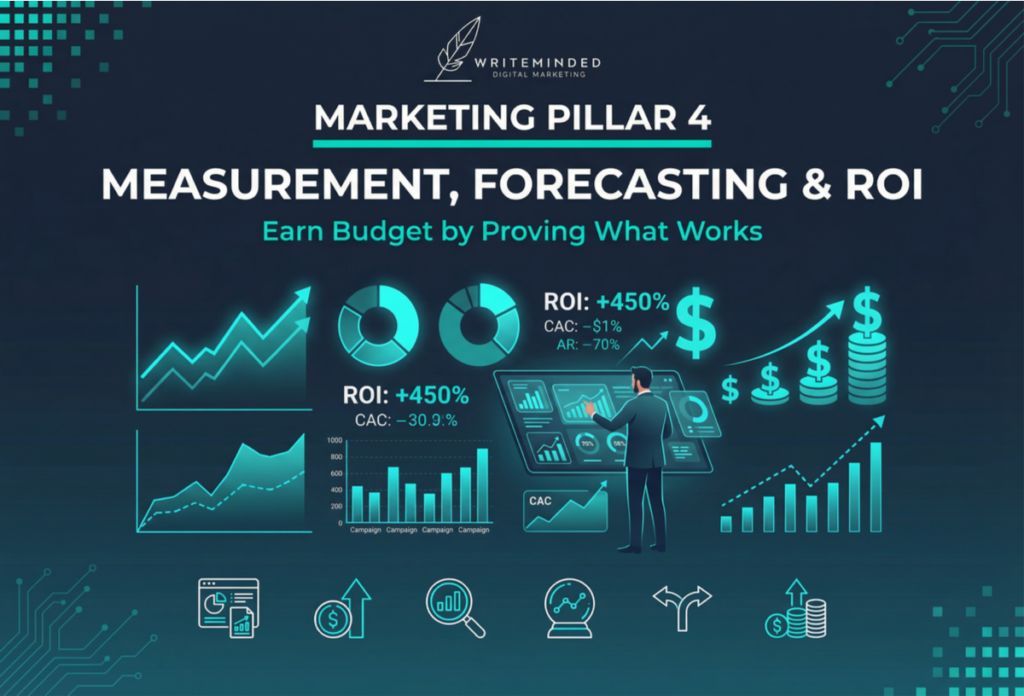
Marketing Pillar 4: Measurement, Forecasting & ROI — Earn Budget by Proving What Works
https://www.writemindedllc.com/marketing-metrics-and-measurement/In 2026, marketing leaders who can’t connect their marketing strategy to financial outcomes will lose credibility, budget, and headcount. The C-suite no longer tolerates vanity metrics; they demand a clear, quantifiable narrative that ties every dollar of marketing spend to pipeline, revenue, and marketing ROI. This is where a sophisticated measurement framework becomes your most critical asset. It’s not about more dashboards; it’s about the right dashboards—ones that speak the language of finance and prove your growth engine is working. Modern measurement isn’t a defensive exercise; it’s a strategic offensive. It’s how you secure investment for new channels, justify headcount for new roles, and earn the trust required to take calculated risks. By building a system that tracks performance from first touch to closed-won, you transform marketing from a perceived cost center into a predictable revenue driver. The CFO-Ready Dashboard: Tying Marketing Strategy to Financial Reality Your CEO and CFO don’t think in terms of clicks, impressions, or even MQLs. They think in terms of customer acquisition cost (CAC), payback period, and pipeline velocity. A CFO-ready dashboard translates your marketing activities into these financial realities. It’s the bridge between your campaign execution and the company’s balance sheet. What a CFO-Ready Dashboard Includes: Metric Description Why It Matters to the C-Suite Pipeline Created/Influenced The total value of sales opportunities generated or touched by marketing activities. Directly connects marketing spend to future revenue potential. Customer Acquisition Cost (CAC) The total cost of sales and marketing to acquire a new customer. Measures the efficiency of your growth engine. A declining CAC is a powerful indicator of a scalable marketing strategy. Payback Period The time it takes for a new customer to generate enough revenue to cover their CAC. Shorter payback periods mean faster, more profitable growth and improved cash flow. Lead-to-Close Velocity The average time it takes for a lead to become a paying customer. Faster velocity means a more efficient sales cycle and quicker revenue recognition. Building this dashboard requires tight alignment with RevOps and Finance to ensure data integrity. When you can confidently present these metrics, you’re no longer just asking for budget; you’re presenting a data-backed investment case with a clear expected marketing ROI. From Lead Volume to Lead Quality: Proving Your Marketing ROI For years, marketing teams were incentivized to generate a high volume of leads, regardless of their quality. That era is over. In a resource-constrained environment, the focus has shifted decisively to lead quality. A single high-intent lead from the right-fit company is infinitely more valuable than a hundred low-quality leads that waste your sales team’s time. Tracking lead quality requires a system that follows the prospect’s journey from their first interaction with your brand to the moment they sign a contract. This involves: When you can demonstrate that your marketing strategy is not just generating activity but attracting high-quality prospects who become profitable customers, you prove your value in the most undeniable way possible. The Predictive Power of AI: Forecasting and Budgeting with Confidence The rise of AI has transformed marketing measurement from a reactive, backward-looking exercise into a proactive, forward-looking one. AI-assisted forecasting and testing allow you to model potential outcomes, de-risk your investments, and allocate your budget with unprecedented confidence. AI-Enhanced Measurement in Action: By embracing these AI-driven capabilities, you move from simply reporting on what happened to confidently predicting what will happen next. This is the final step in transforming your marketing function into a strategic powerhouse that doesn’t just request budget but earns it by proving what works—and what will work next.